Connecting AI to your ERP: why waiting costs more than starting
In short, using AI (drafting an email, summarising a document) has little to do with connecting it to your company's data: the first knows the world, the second reasons over your real numbers. On that second topic, waiting costs more than starting, because the advantage compounds: context accumulates, usage skill is earned, and data quality gets fixed as you go. Starting does not mean automating everything: it means connecting in read-only mode and observing. The first step is small.
For two years now you have been hearing about artificial intelligence everywhere. You have probably already tried a conversational assistant to write a letter or summarise a report. It is convenient, but let us be honest: it changed nothing about how you actually run your company. Hence a perfectly legitimate stance: wait until the topic gets serious before spending time and money on it.
This article starts from a distinction few people take the time to draw: connecting AI to your ERP is not the same topic as "using AI". And on that specific topic, waiting costs more than starting, for a mechanical reason we will lay out. We will look at what actually changes, why the head start of those who begin early widens instead of closing, how to answer the legitimate objections, and where to begin without taking any risk.
"Using AI" and "connecting AI to your data" are two different topics#
This is the most important distinction in the article, and it is not technical at all. A general-purpose AI knows the world. It can explain what a margin is, how an average payment delay is calculated, or draft a polite reminder. What it cannot do is tell you where your margin leaks, which customer pays you three weeks late, or which product has been sitting in your warehouse for a year. It knows nothing about your business.
An AI connected to your ERP works the other way around. It reasons over your real figures: your customers, your products, your lead times, your cash. It is the difference between a brilliant consultant who has never seen your books, and the same consultant after three days spent inside your data. The first hands you principles. The second tells you what to do on Monday morning.
This has to be said plainly, even by someone who sells this kind of tool: the value does not come from the AI model. Everyone has access to the same models, and they improve for everyone at the same time. The value comes from what the model is connected to, and from its ability to regularly cross-reference sources that nobody in a small or mid-sized company has time to reconcile by hand. That is where steering happens, and it is a topic distinct from individual productivity.
What it actually changes, in three examples#
Nothing beats simple cases. Here are three questions every business leader faces, hard to settle today because they require combining several sources.
A customer's real profitability. Is the big account you pamper actually profitable? The answer is not in revenue. Once you factor in the discounts granted, the returns, the shipping costs and above all the payment delays, that prestigious customer can turn out to have a negative margin. Impossible to see without combining at least three sources, and nobody does it by hand every month. An AI connected to the ERP does it several times a day.
Dormant stock. No native alert spontaneously tells you that an item has not moved in twelve months. Cash stays locked up silently, spread across dozens of references, none of which, taken alone, triggers attention. We covered this calculation in a dedicated piece on dormant stock in Odoo. The information is already in your system; what is missing is someone looking at it.
Quotes with no follow-up. A warm quote goes cold in a few weeks. The data is there, the alert is not. The salesperson moves on to the next deal, and an opportunity that only needed a nudge fades for lack of a timely signal.
The common thread across the three is the real lesson: the data is already there. What is missing is not more data, it is the cross-referencing and the timing. That is exactly what an automatic analysis layer brings, and it is why the topic deserves better than a "we will see later".
Why the advantage compounds#
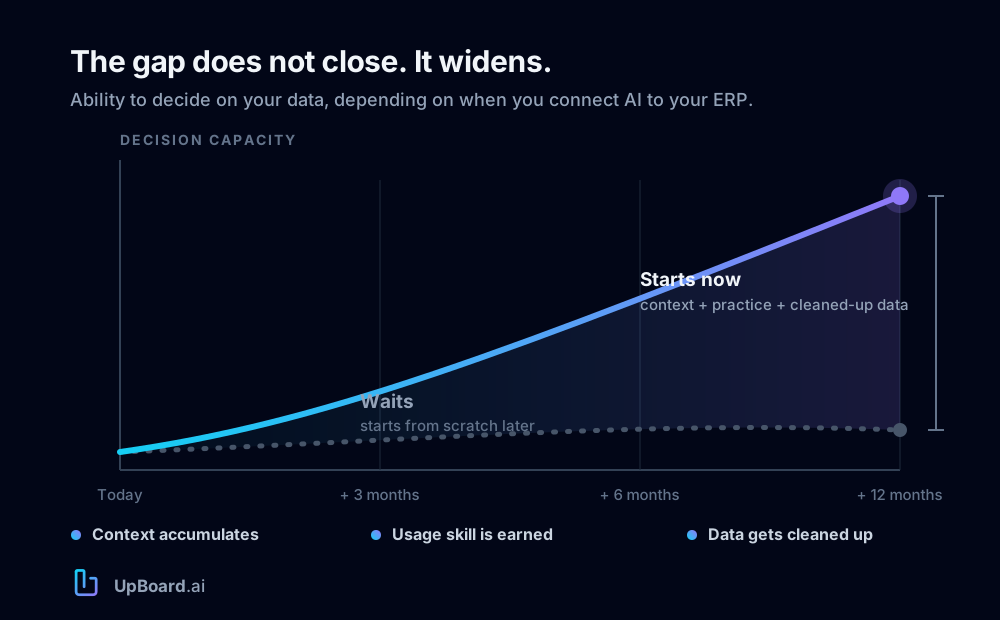
Here is the heart of the article. The argument is not "hurry up, your competitors are coming". That is a dated and unconvincing line. The argument is stronger: the advantage is cumulative, so the delay is too. Three mechanisms make a head start hard to close.
Context accumulates#
An AI connected to an ERP becomes more relevant as it watches months of transactions go by: the seasonality of your activity, your customers' payment habits, your product cycles. Whoever starts in January has, by December, a full year of context that whoever starts in December does not yet have. That context cannot be bought at a premium at the last minute. It builds up by letting time do its work.
Usage skill is earned#
Knowing what to ask, which sources to combine, which decisions to delegate and which to keep for yourself, all of that is learned by practising. Practitioners consistently observe it: the first few weeks mostly serve to calibrate your own judgement, to tell the useful alert from the noise. This usage maturity cannot be downloaded. It is built, and it stays in the company even as the tool evolves.
Data quality gets fixed as you go#
This is the most underestimated mechanism. The first real benefit of connecting AI to your ERP is not prediction: it is diagnosis. You discover what is wrong in your data, duplicate customers, incomplete product records, misapplied payments. This cleanup takes months and conditions everything else, because no fine-grained analysis is reliable on shaky data. Whoever starts late starts at the beginning, while others are already working from cleaned-up data.
The consequence: this is not a sprint where you catch up by accelerating. It is a gap that widens while you wait.
An honest caveat is in order, otherwise all of this reads like a sales pitch. Starting early does not mean automating everything at once. Starting means connecting and observing, not handing decisions to a machine on day one. The urgency is about beginning the learning, not about delegating everything.
Three legitimate objections, taken seriously#
Waving objections away would be dishonest, and unconvincing. Here they are, addressed frankly.
"My data is not clean enough." This is almost always true, and it is precisely the reason to start, not to wait. Surfacing the anomalies is the first benefit, not a prerequisite. Waiting for perfect data before connecting a diagnostic tool is like waiting to be cured before seeing the doctor. The tool is there exactly to show you what needs fixing.
"I do not want an AI touching my ERP." An essential distinction: read-only versus write. A diagnosis changes nothing in your system, it simply reads and analyses. And even when it is time to act, the sound principle is simple: the AI prepares, the human approves. Nothing should run without your explicit consent. That rule is not a comfort feature, it is the condition for staying in control.
"I do not have the time." This is the objection that, turned around, becomes the best reason to start. The time spent every week compiling figures by hand into spreadsheets, reconciling exports, hunting for scattered information, far exceeds the time of a setup. You are not short on time because you have not connected AI yet; you are short on time in part because you have not.
Where to start, concretely#
The good news is that the first step is small. This is not a six-month ERP project. It is a connection and a first read. Here is a progression anyone can follow, no technical profile required.
- Diagnose. Connect your ERP in read-only mode and look at what comes back. No risk, no change to your system, and you immediately get a real picture of your data and your blind spots.
- Observe for a few weeks. Let it run and watch: which alerts are relevant, which are noise? This phase is what teaches you to use the tool and to calibrate your trust.
- Automate what is ready. And only then, with human approval on any action that writes to the ERP. You automate only what you have understood and seen work.
This progression has a virtue: it is reversible and low-stakes. You are not committing your organisation, you are opening a window to observe. That is also what sets a dedicated analysis layer, such as the AI for Odoo we are building, apart from a classic IT project: it plugs into what you already have and hands you a reading, without disrupting anything.
Conclusion#
The real question is not whether AI connected to business data will become the norm. It will. The question is where you will be when it does. Those who by then have a year of accumulated context, a year of practice and already cleaned-up data will not simply be a year ahead: they will be on a different curve, hard to reach by accelerating.
Your caution so far was legitimate: "using AI" genuinely had little to do with how you steer. But connecting AI to your data is another topic, and on that one, starting early mostly means giving yourself the time to learn calmly, without pressure. To compare what Odoo's native AI already covers with what a dedicated layer adds, we wrote an honest comparison of Odoo 19 native AI versus a dedicated solution.
If you simply want to see what your data reveals, the UpBoard scan gives you a first picture in a few minutes, read-only and with no commitment, and the 14-day free trial lets you go further at your own pace.
Read next
- Odoo 19 native AI vs dedicated solution: the 2026 choiceOdoo 19 AI: what the native AI does well, where it falls short for steering the business, and when a dedicated layer is worth it. An honest comparison.
- Dormant stock in Odoo: how to calculate, value and reduce itDormant stock in Odoo: a step-by-step method to identify it, value it in euros, understand its real cost and reduce it for good. A practical SME guide.
- The 7 KPIs every SMB CEO should track each MondaySMB CEO KPIs: cash, DSO, margin, pipeline, stock, overdues, support. The 7 numbers to read every Monday morning, with concrete action thresholds.
See what your Odoo data has to tell you
A few minutes, read-only, no card. Then a trial on your real data: 14 days, or until the trial credit is used up.
Rather talk it through? Book a demo